Sharing with you a list of HR, Training, Learning conferences in India. Most of these are annual conferences.
Drop me a note in comments section in case I missed out a conference that you feel should be added to the list.
Many years ago a recruiter connected with me. During our conversation he asked me what's my tag line. My tag line, what's that? I asked. He said, you know, like someone is a "Problem Solver", or "Deal Closer" etc. You need to have a tag line that describes you, he said to me.
The conversation got me thinking. Before that time I had never thought what was my tag line. After some thought, I chose "Enabling People" as my tag line. I like to enable people deliver better, by creating an environment that enables them to succeed, by sharing knowledge, by learning from them, by encouraging free ideas and thoughts, This could be my team, my clients, or my friends and family.
What's your tag line?
So we've moved away from moderation in performance appraisal in our organization. Over the years moderation seemed the best though not always perfect way to grade performance of people. It made sense to rank people with relative performance levels. There was a bell curve to be followed forcing supervisors to push people in defined performance bands. However, the most difficult part was to push people in lowest performance bands. It was imperative that we identify the top performers and the worst performers. Not every supervisor was able to rank people in the lowest performance band. And then supervisors used moderation as an excuse. It was easy for them to blame the moderation process. "You are good but I can't help it, moderation forces me to push you in the lowest performance band" was a common excuse. People weren't too happy. Why should a stupid system force one to be in the lowest performance band even when the supervisor believed that the performance was good?
Getting rid of moderation process seems to be a brilliant idea. Afterall, all I need to compete is with myself. My performance shouldn't be dependent on others. No more bell curve was liberating. Supervisors didn't need to spend endless hours force fitting people into performance bands.
But this liberation didn't come without challenges. Suddenly everyone was either the top performer or the worst performer depending on how the supervisor set goals. Given the difficulty of giving negative feedback, almost everyone ended up being a good performer even though business results showed otherwise.
When you do away with moderation, it is critical that goals need to be measurable and assignable to individual performance. Over time, our goal setting is getting better making performance evaluation more objective. We also need to get better at measurement. Data collection against goals is being improved. Evaluation against parameters are being optimized. But challenges remain. Not all goals are easily measurable. Team goals are hard to evaluate against specific individual performances. And then there are circumstances during the year that impact performance against goals that are hard to take into account.
While the process is getting better, I sometimes wonder if moderation in performance appraisal was better. It gave us ability to, well, moderate relative performance. I want the best of both worlds. No matter how objective performance evaluation is, I believe some subjectivity in performance evaluation is imperative to take into account circumstances during the year, to take into account the problems with goal setting that might have been there, to take into account the expectations from the individual that might not have been considered during goal setting for a role. I wonder if it is possible to have some sort of objective subjectivity in performance evaluation?
Labels:
appraisal,
constructive feedback,
feedback,
firing people,
HR,
Leadership,
making people succeed,
Management,
negative feedback,
people,
people management,
performance,
performance management,
Success,
Work
We mostly hear how hard it is to give negative feedback and fire people. I have been wondering about this. Yes giving negative feedback is hard and firing people is harder. However come to think of it, actually this is a easiest thing. We are all critical of others and so giving negative feedback comes naturally. We more often than not, find it easier to find mistakes rather than appreciate what's going on well. And if a subordinate isn't working out, firing is an easy way out. The work pressures are high and we can't afford a non-performer on the team, right. Actually, that is the easy way out. What's really hard is to make the non-performers succeed. That is the true challenge of leadership.
In a recent post,
RWW reports that “In a study of 300 hiring managers and
recruiters, Palo Alto-based social networking monitoring service Reppler
reports that 76% of hiring managers look at applicants' Facebook profiles. An
additional 56% are looking at Twitter, and 48% check out LinkedIn.”
The fact that recruiters should be checking out basic info
on social networks makes perfect sense to me. Unfortunately this doesn’t seem
true, at least for Indian recruiters. I recently got a call from a recruiter,
apparently someone involved in senior level recruitment in a reputed
recruitment firm in India. So this guy starts with introducing himself and how
he is specifically focused on senior level recruitment and how they carefully handpick
the candidates for select senior level jobs. He goes on to say that he got my
reference through someone (he wouldn’t reveal his ‘source’).
After the pleasantries, he asks me about my career background.
I said my career profile is listed on LinkedIn and asked him if he had checked
that before calling me.
Oh we don’t check LinkedIn profiles, we are required identify
candidates from independent sources, he says to my surprise.
Sure, that’s okay but having identified me from independent
sources, why haven’t you checked my public profile before calling me?
Oh no, we aren’t supposed to do that.
Duh!!!!!!!!
Why don’t the recruiters realize that they are wasting the
candidate’s and their own time by not reviewing the profile on social networking
sites? Surely they will be able to find a better job-candidate match by
reviewing the profile before they approach the candidates.

In a recent
employee survey by Mercer it was found that one in two employee is seriously considering leaving their jobs for better opportunities in terms of career and base pay. Interestingly around 66% of employees under age 24 are seriously considering leaving. It leads to an interesting question that I have been pondering over and researching informally:
Is changing jobs the best way to get a raise?
After say more than 15 years work experience, do you think someone who has hopped jobs more regularly will be paid more than someone who has spent longer in each job? While I haven't done any serious research, however based on the senior level profiles I come across, I haven't yet found substantial evidence of job hoping really making a significant impact on the ability to get more pay in the long run. I haven't particularly found people with more job changes at higher salary levels than the ones who might have stayed in organizations longer.
It would be interesting to have a survey for people with say more than 15 years of work experience. Would love to hear your observations on this. Do take the time to respond below.
See
responses here.
Image by s_falkow
@sidin posed a question on Twitter about lies we give while quitting a job. I am sure there’s a full article out with a lot more research.
Over the years, I have heard many reasons that people give while quitting. These reasons are not necessarily lies in all cases. These are just a collection of some reasons that I figured were lies after the person had left the organization.
"I want to do something different" (when the will continue in the same industry doing the same thing)
"I am getting a better role" (when they will do exactly what they were earlier doing)
"I am getting a better designation" (when they aren't)
"I want to take a break" (and they promptly join another company)
"I have to go to my hometown because my parents are old/unwell" (and they promptly join another company in the same city)
"My spouse is getting transferred" (and I find either the spouse to be in the same city, or they have joined another company in the same city)
"I am joining a full time course" (and they promptly join another company)
“I have to join my family business” (and they promptly join another company)
What are some of the lies you have heard or have given while quitting an organization?
Labels:
Career,
Change management,
coaching,
HR,
Jobs,
Leadership,
performance management,
Promotion,
Supervisor,
Tips,
Work
I came across Dan McCarthy’s blog recently. Dan is a practitioner in the field of leadership development for over 20 years and is currently the Manager of Leadership and Management Development at a Fortune "Great Place to Work", "Training Top 125", and "High Impact Learning" (HILO 80) company. He has a great blog on leadership that I would encourage you to subscribe to.

Dan wrote a great post Head’s Up – You are About to be Promoted or Fired where he shares why you might get promoted or fired. I think there’s also a third script: the status quo script. While you may not be fired for things you do (or don’t do), you may not get promoted either. Here’s what the script might be why you are not getting promoted:
Status Quo script:
I have some good news - you are keeping your job. Unfortunately we aren’t promoting you. Here’s why:
- You are not seen as a leader amongst your peers. You do your job well enough. However you don’t inspire others, either within your team or amongst your peers. People respect you for doing your job with the best intentions and spirit but don’t really look up to you for taking them to the next level.
- You don’t take initiatives. If there is a new opportunity, you don’t volunteer. You don’t seem to have new ideas. You usually wait to be assigned tasks and you are happy to do what is assigned to you, which you do well, no doubt. Perhaps you are content and satisfied with your current role.
- You are not adding value to your current role. For example, your role is not just to create and present the report, but also work towards improving what you are presenting.
- You are not visible. You don’t participate in company initiatives. You avoid official social gatherings. You don’t participate in cross functional teams. You shy away from taking credit for the good work you or your team does. You rarely share what you know, people don’t really see you as a node of reference.
- You resist change. If there is talk of changing process or tools, you resist it. Your first reaction to initiatives is that it can't be done. It is too hard to convince you about the new ideas or changes and too much time needs to be spent with you to onboard you. People see you as an impediment to new ideas.
Picture by
I recently discovered how I can effectively use LinkedIn to find potential candidates for recruitment. I simply update my status message with what I am looking for and get responses from interested candidates. Okay, I know this isn’t really new but hey, it’s new for me. Anyway this post isn’t about this discovery of mine.
I received a few responses to my status updates. These were from people I know and have worked with in the past. Unfortunately, a few of the people who responded did not have an updated LinkedIn profile. Their profile simply listed the jobs they held but had not details about what they did in each job or their achievements. Since I knew these people personally, I had a good idea of their profiles and the jobs they have held since they moved on. However I possibly couldn’t forward their profiles to my other colleagues because of their incomplete profiles. Lost opportunity!
I recommend that you update your LinkedIn profile with details of what you did in each job you held. Include your achievements too. Consider LinkedIn profile your updated and most recent résumé, even if you are not actively looking for a job. And do remember to write a Summary and Specialities too.
If you want to connect with me on LinkedIn, simply add me to your network. On my LinkedIn profile, click Add Manish to Your Network, select Other and put in my email manishmo [at] hotmail [dot] com. Please do provide some introduction about yourself in your initial connecting message.
It’s happened to me a few times now. We are going somewhere and I am asked to follow someone else’s car. I observed three types of leaders:
1. The Highly skilled but somewhat Self-Centred Leader: The driver in the car ahead of me just zooms past leaving me to figure out the way myself. They are usually very skilled at manoeuvring through the traffic themselves. You will usually lose them at a traffic signal that they go past leaving you stranded waiting for the light to turn. They are nowhere to be found after the light turns green for you and you are left to find your own way.
2. The Spoon-feeding, Risk-Averse Leader: The driver in the car ahead of me treats me like a first time driver. They don’t realize the driving skills I already have. They go very slowly and cautiously so as to not lose me but in the process make me lose interest and want me to overtake them. Their slow pace could also be because they themselves don’t know the way or are new drivers themselves.
3. The Leader who you gets you to destination smoothly: The driver in the car ahead of me defines the pace I go at. They always keep an eye on me in the rear view mirror and make sure they don’t lose me. At the same time they don’t let me slow down too much, pushing me to speed up when they do. They are always waiting for me to catch up in case they lose me on a traffic signal.
So what do you do when you have someone following you, in a car or otherwise at work? Do you show off your skills and leave the followers behind to catch up? Do you consider their prior experience and leverage that or challenge them with a faster pace? Do you make sure you don’t leave anyone behind while ensuring that you maintain speed to reach your goals?
In my second case study, we look at a situation when one of the peers is expected to take on the leadership position amongst the team. Looking forward to your responses to learn what we can do in situations like these.
A meeting alert window popped up on Ajay’s computer reminding him of his meeting with Sangeeta, his boss. He clicked the snooze button and continued making last minutes changes to the spreadsheet he was working on. He was compiling performance data for his team that would be discussed in the impending meeting. The alert popped up again. Ajay disconnected his laptop and looked for a pen.
Sangeeta beckoned Ajay through the glass door and Ajay walked in her office without waiting. Ajay’s team had grown significantly and Sangeeta felt that all projects were not getting due attention. Also not all team members were getting the coaching that Ajay was capable of providing because he was spread too thin.
“I feel you need a Team Leader in your team Ajay. Have you got any suggestions?” Sangeeta started. They had recently discussed the growth of Ajay’s team and the related issues.
“Well, Archana and Rahul are the two key players in my team. Both are equally capable.” Ajay said as he opened his laptop.
“Who is more capable of leading a team? I understand that both are equally capable of executing projects, but we are really looking for leadership skills here.” Sangeeta said.
“Rahul is actually very good in customer communications. His work is also always very good and gets approved in the first round itself. And Archana is equally good. Rahul likes to be sure of what he is planning to do and bounces things off me while Archana goes ahead and takes decisions on her own.”
“And are her decisions wrong?” Sangeeta probed.
“Actually she has a good instinct. And she usually backs it up with well thought through strategy.” Ajay explained.
“What about the team? Which one of them works better with the team?”
“Rahul is just great with the team. He’s a great listener, practically an agony aunt actually. He almost never says anything negative to his team members. The team loves him. Archana’s also good with people but she’s more task focussed. She shows the team a vision and a goal and then helps them achieve it.” Ajay felt good that he had thought through strengths and weaknesses of Rahul and Archana.
“Seems like Archana probably will make a better Team Leader don’t you think?” Sangeeta asked.
“Most probably… but Rahul’s really good too. I don’t think we can ignore him. I wouldn’t want to lose him.” Ajay was beginning to look worried. He knew Archana was more independent and stronger and more capable leader of the two and yet was worried about what Rahul might feel about reporting to someone who has been his peer.
“Ajay, only one person can be the Team Leader, you know that.”
How do you think Ajay should handle the situation? How should he communicate to Archana and Rahul about the new Team Leader position?
How will Rahul take the news? What do you think he should do now that he will need to report to his peer?
How can Archana make Rahul more comfortable as a Team Leader? How can she graduate from the peer relationship to a supervisor relationship?
If you haven't yet visited and subscribed to the
Indexed blog by Jessica Hagy, do so now. It's just brilliant!!!
Today's diagram is something that I can really relate to.
In my second part in the series, I share what Manish Sabharwal spoke at our annual strategy input conference.
Manish Sabharwal is the Chairman and co-founder of
TeamLease. Manish wanted to start a new company that was profitable, fun, and good for India. He co-founded Team Lease, a staffing company, and in six years his company has grown to 80,000 employees and $250 million company. It was great fun listening to Manish again this year.
According to Manish, vocational training has to come with a job. There has been an employment failure. No one is really willing to pay for training. The employers are not willing to pay for training but for trained candidates. Candidates are not willing to pay for training but for a job, and financers are not willing to lend for training but to a candidate with a job.
Manish is working towards making labour markets more inclusive. The labour market has seen many transitions lately:
- Farm to non-farm
- Rural to urban
- Unorganized to organized
- Subsistence self-employment to decent wage employment
- School to work
Commenting on the economic conditions, he says while there may be a slow down but there is no shutdown. Manish’s company still finds it difficult to find people for jobs. They have more than 4000 open jobs on any given day that need to be fulfilled. The problem is not that there are no jobs, the problem is that the workforce is not employable. And rural India doesn’t have the same choices as the urban India in terms of the jobs they might qualify for.
The way he sees the current situation, in the immediate term the immediate strategy is that of Matching, which is matching the workforce to the right jobs. Medium term the strategy is to reduce the mismatch. He calls this ‘Repair training’, skilling the existing workforce to close the skill gaps. And long term, the strategy is to build the pipeline, preparing the workforce for the jobs. He calls this ‘Prepare training’.
Manish laments to the poor education regime in India. There is low penetration of education, low returns to education, uneven quality of education, and while the system is accreditation heavy the outcome is light.
Manish also talks about the poor employability and employment regime. He describes the entry and exit gates (e.g. IIT, CA exams) in the education systems not meeting the requirements of the employment available in the market. He feels the current assessment systems are just not suitable and cannot really identify the right candidates. In spite of various assessment systems, the actual performance at workplace still seems to be the luck of a draw. Manish would really like to see more apprenticeship, more learning by doing, and the government policies current don’t encourage that.
Manish talks about lopsided GDP. Very few people contribute to a large part of India’s GDP and he would like more people employed and contributing to the GDP. He also feels that we are missing the middle – there can only be a hero or a zero. He wants us as a society to accept the ‘middle’. Not everyone is a hero and not everyone is a zero.
It was also interesting to know that employment exchanges in India are in a really bad state. There are 4 crore people registered and only 2 lakh jobs provided across India. The Delhi employment exchange gave 500 jobs last year at the cost of Rs. 2.5 lakh each! (1 lakh = 100K, 1 crore = 10million)
For building a pipeline, Manish feels quantity comes first and then quality. He feels we should get the critical mass and then refine the process/delivery as we go along; the good is not the enemy of great, e.g. not looking for Einstein for Front Office Sales; we are not trying to be right, we are trying to be successful. He urges the education system to include softskills and communication skills in schools and colleges.
It was interesting to hear him say that knowledge of English language is a must. He says English is like Windows, it is an operating system. We can like it or hate it, but we need it.
According to Manish, we can’t have employment and employability conversations independently. To increase employment, we have to improve the employability. Skill deficit is worse than the infrastructure deficit, and an unemployed or unemployable India is not free India.
Finally let me leave you with this interesting quote:
Entrepreneurship is the art of staying alive long enough to get lucky
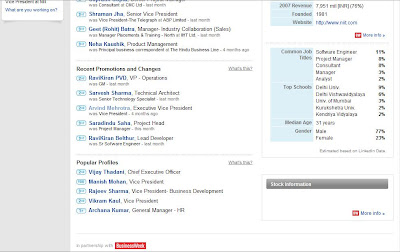
There is enough written about using LinkedIn. However I recently discovered an interesting feature on LinkedIn from a company’s point of view. Since the official LinkedIn blog introduces this feature on Aug 18, I am guessing it is a new addition to LinkedIn.
LinkedIn now has hundreds of Company Profiles. Select Companies link on the top links bar. You can view companies by location, industry, name, and companies in your network.
 (this grab from LinkedIn blog)
On the company profile there are some interesting pieces of information. It shows career paths of employees before and after their employment with the company. It also shows employees most connected to which other companies. Aha, that’s where most of our employees are headed...

The company profile shows new hires, and recent promotions and changes of employees. More interestingly, under Key Statistics section it shows common job titles. These are job titles of employees in the company who have registered with LinkedIn. So in my company Software Engineers, followed by Project Managers and Consultants are the most common job titles on LinkedIn. Hope this provides some useful information to HR.

The Key Statistics section also shows that of all the people from my company on LinkedIn, 77% are males. I know for sure that the gender ratio is pretty much even in our company. So does this mean that males from my company are more likely to be using LinkedIn than females?
Finally it shows popular profiles from the company. Does it help if my profile shows up as the second most popular profile after the CEO of the company? :-)
Related links:
In continuation of my earlier post on
CEO and corporate blogs, I found this video on
Mark Oehlert's blog.
Update: See 2009 elearning and content development salary data here
There's an interesting debate raging in various forums about salaries in elearning/content development jobs in India. So here's starting an unofficial survey about salaries in this field. Nothing official about this survey -- all inputs available here are completely anecdotal and open to interperations by the readers. I do not make any claims about accuracy of these figures.
Add your comments in this blog about the salaries you have seen for various roles in various companies in India. And while you are at it, also add what do you want the salaries to be. This survey is not limited to instructional designers and technical writers. Feel free to provide inputs about salaries for other functions too.
Existing companiesRole:
Job title:
Education:
Relevant experience
Salary range (annual CTC):
Cool benefits:
Company size (# of people etc.):
# of people in elearning/content development:
City:
What I wantRole:
Job title:
Education:
Relevant experience
Salary range (annual CTC):
Cool benefits:
Company size (# of people etc.):
City:
Update:
Results of 2008 Unofficial Salary Survey of elearning and content development jobs in India.
I have been fascinated by the recent advertisements of job sites. All bosses are shown as being really mean. Remember Hari Sadu? Or the bosses in ‘Guess whose heard from us lately’ ad. It’s really funny watching these ads. Remind me of old bollywood films (actually true for many new ones too) where characters are shown with exaggerated stereotypical characteristics.
And then there is the Happy Kumar ad. It reminds me of a conversation I had with someone who came to me to discuss this ‘fantastic’ offer she had and wanted my advice. In conversation with her, she mentioned that this offer would require her to relocate to a city where she did not want to go. And that she was actually very happy doing what she was and she was happy with the money she was getting currently. And the new job wasn’t something she wanted to do. I was very puzzled and wondered why she wanted my advice. She said, but hey this is a great offer. I wondered if Happy Kumar syndrome had caught up with her. Being happy and satisfied with your job is not such a good thing after all.
The most recent ad is about your pay packet making you feel small. This ad propagates that money is the only yardstick of how companies can show appreciation of talent. I wonder what this job site’s attrition rate is and what they pay to their people. And would money compensate for Hari Sadu? Surely no one will leave Hari Sadu if he paid more money. And we already know Happy Kumar is a really bad boy, being satisfied with what he is doing and all that.
Times have changed. Our parents spent most of their careers with one organization. This of course does not mean that we should spend our careers with only one organization. The fact is that there are indeed a lot more opportunities available now. ‘India Shining’ screams at us in the face. However I think we have gone to the other extreme now. It is now fashionable to change jobs at regular intervals. Does this regular change of jobs impact the individual or is it actually good? Will we really getting better at what we do if we keep changing jobs so frequently? Are we building a foundation or eroding our base?


 In a recent employee survey by Mercer it was found that one in two employee is seriously considering leaving their jobs for better opportunities in terms of career and base pay. Interestingly around 66% of employees under age 24 are seriously considering leaving. It leads to an interesting question that I have been pondering over and researching informally: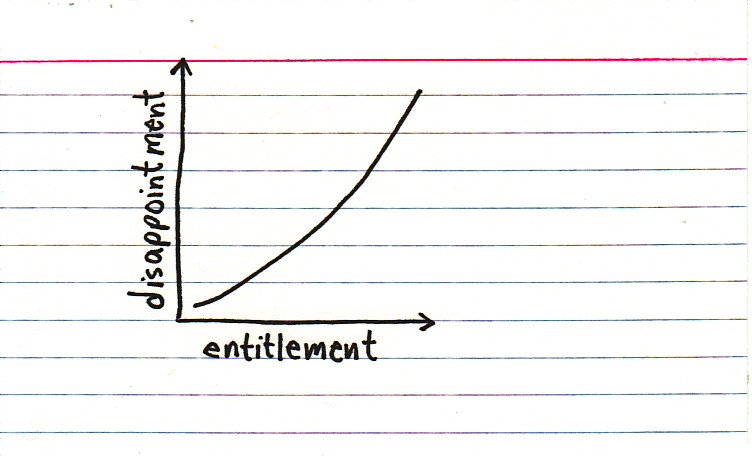
 (this grab from LinkedIn blog)


 This work by Manish Mohan is licensed under a Creative Commons Attribution-Noncommercial-Share Alike 2.5 India License.


