
We mostly hear how hard it is to give negative feedback and fire people. I have been wondering about this. Yes giving negative feedback is hard and firing people is harder. However come to think of it, actually this is a easiest thing. We are all critical of others and so giving negative feedback comes naturally. We more often than not, find it easier to find mistakes rather than appreciate what's going on well. And if a subordinate isn't working out, firing is an easy way out. The work pressures are high and we can't afford a non-performer on the team, right. Actually, that is the easy way out. What's really hard is to make the non-performers succeed. That is the true challenge of leadership.
Showing posts with label Work. Show all posts
Showing posts with label Work. Show all posts


@sidin posed a question on Twitter about lies we give while quitting a job. I am sure there’s a full article out with a lot more research.
Over the years, I have heard many reasons that people give while quitting. These reasons are not necessarily lies in all cases. These are just a collection of some reasons that I figured were lies after the person had left the organization.
"I want to do something different" (when the will continue in the same industry doing the same thing)
"I am getting a better role" (when they will do exactly what they were earlier doing)
"I am getting a better designation" (when they aren't)
"I want to take a break" (and they promptly join another company)
"I have to go to my hometown because my parents are old/unwell" (and they promptly join another company in the same city)
"My spouse is getting transferred" (and I find either the spouse to be in the same city, or they have joined another company in the same city)
"I am joining a full time course" (and they promptly join another company)
“I have to join my family business” (and they promptly join another company)
What are some of the lies you have heard or have given while quitting an organization?
Career Paths for Trainers
Labels:
Career,
career paths,
Jobs,
Learning,
Management,
people management,
trainers,
Training,
Work,
Workplace
2
comments
Someone asked a question on the career growth paths for trainers on one of our internal forums. And about the same time I came across this interesting blog post which talks about not worrying about career path and living your career story, written by Jason Seiden. It is from Dan McCarthy’s list of 20 Best Leadership Blog Posts of 2010. Just loved the way Jason explains the need to dump career paths and focus on building your career stories.
So, what could be a Trainer's career stories? While it is really for each one to decide for themselves, I can imagine some of them going like these:
- A trainer could become a better trainer. This seems to be least favorite path of trainers but is the most crucial and can take trainers to the peak. It is also the hardest in my view. By becoming better trainers I mean really be known in the industry. Build your social network and stay in touch with your students. Continue providing them assistance post training. Be less of 'sage on stage' and more of a 'coach by the side'. Start a blog and write a book on your subject or on how to become a better trainer. Understand how people learn and create training practices that help people learn faster. Do research on the subject of training and learning. If you are in the training business, there is a great scope for better trainers who go beyond training in a class and help build learning solutions, who can do research and appropriately adapt their training strategies, or even create new ones, who can create new standards in the training industry.
- Depending on the acumen towards operations, people management and business, trainers could move to roles like managing training, handling projects and other ops roles. Trainers could even take on sales/business roles. They could move to manage training centers, area, territory, region, zone, country. Many senior people in our organizations have been trainers at some point of their careers. All training businesses need people with good ops, sales and business management skills and acumen.
- Trainers could become Subject Matter Experts (SMEs) for content development projects. Trainers could even start writing content, depending on the skill and interest. Trainers could become full-fledged content developers. And from there ID specialists, or take the other path of project management. From either path, trainers could move to taking on business or sales roles.
There's no dearth of career growth paths and I am sure there are many more than what I have listed above. What's really important is to figure out what's the career story we want to create for ourselves.

Sanjay is a great team leader aspiring to be a manager. He has shown good results in the projects he has handled. He has shown willingness to go the extra mile in the tasks assigned. He has been constantly told he is a great performer and the company would not like to lose a great team leader. Regular feedback and company awards have made him proud and self confident. However he has had some issues in his ability to handle larger projects and teams. His view of the industry is relatively narrow. His view of a manager’s role is limited and his attitude is bordering towards arrogance and over confidence. He is closed to any feedback about his limitations and refuses to accept inputs to improve his abilities to become a good manager. He will not get the manager’s position that he is aspiring for. He has thrown tantrums that he will start looking for another job that gives him the promotion that he believes he deserves.
Would you simply wait for him to quit his job, paying him while he finds another job? Or would you fire your best performer who is great at the current role but not ready for the next role? Or would you give in to the tantrums and promote him even though he is not ready for the role?
With the job market opening up and companies vying for talent, I foresee a repeat of what was happening couple of years ago. Given the paucity of talent people were promoted to roles they just weren’t ready for. Do you think this will happen again?
Jane Hart seeks rebuttal to reasons commonly given by organizations for banning social media at work. I have heard some of these. Here’s why I believe organizations should NOT ban social media, rather find ways to leverage it. Some of these are in the Indian context of hiring and retaining workforce. I am adding an 11th reason that I have heard for why organizations ban social media that could perhaps make it to the list.
11. Social media takes up too much of company’s Internet bandwidth hampering other work.
Given the advantages of social media, and reducing cost of bandwidth, it might be a very worthwhile investment by the organization. Investing in bandwidth is probably as critical, if not more, than investing in higher-end machines and laptops.
10. Social media is a fad.
If so do you want to be left behind and not know anything about it?
9. It’s about controlling the message.
If it is are you using the channels available to you and the employees? Just because social media is banned at work does not mean employees don’t have access to it at all. They are on it whether you like it or not. And if you are indeed worried about controlling the message, are you on the same channels are your employees are?
8. Employees will goof off.
If employees have to goof off they will, whether they have access to social media at work or not. If you are managing your work allocation and performance management well, and have the right business measurements in place, it doesn’t really matter whether employees goof off or not. If you are measuring the time they are spending on activities rather than the results they are expected to achieve, you are probably a lawyer or a consultant billing by the hour. I can’t comment on lawyers but as a consultant, you better focus on results or you’ll be out of business.
7. Social media is a time waster.
See point 8.
6. Social media has no business purpose.
If your customers aren’t on social media, investors aren’t on social media, stakeholders are not on social media, employees are not on social media, competition is not on social media, and you don’t believe in continual learning, keeping track of market trends etc., then yeah, perhaps social media serves no business purpose for you.
5. Employees can’t be trusted.
If you can’t trust of your employees, why are you in the business that needs employees? Do you trust them enough to let them talk on phones, use email? Then you can trust them with social media. Yeah sure there are sensitivities of using social media on which you should coach your employees, just as you would to use the phone or email. The video talks about employees can’t be trusted to not put up photos on the office party. Well what’s the harm? It’s a great opportunity to tell the world what a fun place to work your organization is, and therefore attract more talent for your organization, especially when the workforce is getting younger (also see point 4).
4. Don’t cave into the demands of the millennials.
Enough demographic studies show that in India the workforce is getting younger. Wouldn’t you want to create an environment that your workforce relates to and enjoys? Would you want to create an environment that your workforce finds stifling? You could potentially use social media access as a retention strategy.
3. Your teams already share knowledge efficiently.
Cool, so you will understand how social media makes it easier to serve this objective.
2. You’ll get viruses.
So get better anti-virus protection software and better processes to update your computer with latest patches.
1. Your competition isn't using it, so why should you?
Don’t all business gurus tell you to do things your competition isn’t doing to get ahead in business? Do you really have this as a reason for banning social media at work? Duh!
It’s been a slow start to the 2010 Unofficial Salary Survey of eLearning, Content Development and Training jobs. You can now view the responses by following the Responses link.
Some highlights so far:
- Functions that have participated are Instructional Designers (33%) and Technology/Programmers (22%), followed by Project management (17%) and Graphics and Media (11%).
- Most participants have 10 years work experience (28%) followed by 5 and 3 years (11% each).
- So far the survey seems to be dominated by male responders (72%).
- Only 28% people switched jobs last year.
- Mostly people from elearning/training vendors have participated (72%).
- City spread is fairly even with nearly equal participation from NCR, Mumbai, Hyderabad and Chennai. Surprisingly, Bangalore has had low participation so far.
Some changes I had introduced in this year’s survey were:
- Number of years of experience is more specific rather than a range.
- Salary details are now a number instead of a range. This will help get better inputs about salaries.
- Gender info can help to see if there is any gender inequality in salaries.
- Industry info can help identify salaries in different industries.
The survey can be useful only if more people participate. Do spread the word around.
There's nothing official about this survey. The survey is not based on responses by companies but based on responses provided by you, the employee. This survey is not associated with any organization. The survey is anonymous.
This survey is for you if you are an Instructional Designer, Content Developer, Technical Writer, Project Manager, Graphics designer, Flash Programmer, Content Integrator, Tester, Editor, Trainer, Training administrator, SME, or any other role involved in elearning, content development and training delivery.
Click Unofficial eLearning Salary Survey of India 2010 to participate in the survey. I will publish the findings on my blog here sometime in August/September 2010. This year’s questionnaire attempts to find out more about you and the industry to provide a more in-depth analysis.
Help derive maximum benefit from this survey: spread the word about this survey. Email, Tweet, Facebook, Orkut, LinkedIn and Blog about this page for your friends and colleagues.
Earlier survey findings:
It’s time to launch the 2010 Unofficial Salary Survey for elearning, content development and training jobs in India. There's nothing official about this survey. The survey is not based on responses by companies but based on responses provided by you, the employee. This survey is not associated with any organization. The survey is anonymous.
This survey is for you if you are an Instructional Designer, Content Developer, Technical Writer, Project Manager, Graphics designer, Flash Programmer, Content Integrator, Tester, Editor, Trainer, Training administrator, SME, or any other role involved in elearning, content development and training delivery.
Click Unofficial eLearning Salary Survey of India 2010 to participate in the survey. I will publish the findings on my blog here sometime in August/September 2010. This year’s questionnaire attempts to find out more about you and the industry to provide a more in-depth analysis.
Help derive maximum benefit from this survey: spread the word about this survey. Email, Tweet, Facebook, Orkut, LinkedIn and Blog about this page for your friends and colleagues.
Earlier survey findings:
I recently received an email seeking my advice on how to deal with an office bully.
Hi Manish,
It has been a long time since I interacted with you. The project that I am on is beginning to gain momentum and it seems it's going to be a rugged and enjoyable ride throughout the year.
Today I write seeking your guidance. A guy in the office who has been in the company for not more than 5 or 6 months has developed a tendency somehow for irritating me.
He does this by -
a. Interrupting me when I am saying something.
b. Calling me with funny names in front of other people and in meetings and trainings.
c. Interrupting me when I am talking to a colleague about some project related work.
d. Suddenly slapping my back when I am involved in work calling me with a different name and then walking away.
I have once retorted back and also confronted him to no avail.
He has a known problem with behavior. During an office trip, he got drunk and started making fun of everyone and started cracking vulgar jokes in front of the ladies.
I am a little vexed about how to approach this problem. I don't want to be a part of a formal complaint because it could be seen as manipulation. I am on contract and I don't want to be tainted on account of a jerk. But I have been dealing with his crap everyday for some months now. This affects my work many times because I feel insulted and humiliated.
I have informally discussed this with a colleague who suggested that I should talk to the senior PM but then the project is just gearing up, it needs people and I run the risk of being labeled as someone who is bringing up problems.
Kindly guide me.
Here’s how I responded.
It is unfortunate to hear your plight. I am quite sure there is no one way to deal with what you are going through. You’ll need to figure out for yourself what works best for you. Given the limited knowledge I have of the situation and the persons involved, the options that come to mind are:
- Ignore him, environment will take care of him. If you say that he has a known problem with behavior, he will probably get marginalized in time anyway. If he doesn’t improve his behavior, your boss will ease him out of the team and in all likelihood out the company. Unless of course, this person is really good at what he does, like a real genius. In which, I guess you should learn to live with his banter and try and learn from him. Hard to do I know, but geniuses are known to come with their idiosyncrasies.
- Ignore him, don’t feed his behavior. He is probably doing all that to gain attention. If you don’t give him the attention he is trying to get, perhaps he will stop doing what he is doing.
- Be friends with him. After all, he is probably doing all that just to get attention. It is possible he doesn’t have many friends. Take some time to actually know him. Perhaps his behavior will change if he finds you friendly. Perhaps you won’t find him so irritating if you get to know him better.
- Confront him, one on one. Talk to him one on one. Be open and try to understand his situation. Then explain that you are uncomfortable with his behavior.
- Confront him, take him on. Start calling him names, start paying him back with the same coin. Okay, perhaps not the best idea. May lead to more adversaries and therefore avoidable.
- Talk to your boss, or even HR perhaps. It need not be a formal complaint. Just as you are asking me for advice, you could ask your boss for advice for handling this situation. It’s a good way of letting your boss know of things without complaining.
I believe that if you approach the situation with the openness of understanding the other person better, you will usually find a solution that will work for you. I know it is a lot of words, but I hope you are able to derive something out of that I have written. All the best.
I am not sure if this is all that he could do. What would you suggest?
5 Reasons Why You are Not Being Promoted
Labels:
Career,
Change management,
coaching,
HR,
Jobs,
Leadership,
performance management,
Promotion,
Supervisor,
Tips,
Work
13
comments
I came across Dan McCarthy’s blog recently. Dan is a practitioner in the field of leadership development for over 20 years and is currently the Manager of Leadership and Management Development at a Fortune "Great Place to Work", "Training Top 125", and "High Impact Learning" (HILO 80) company. He has a great blog on leadership that I would encourage you to subscribe to.

Dan wrote a great post Head’s Up – You are About to be Promoted or Fired where he shares why you might get promoted or fired. I think there’s also a third script: the status quo script. While you may not be fired for things you do (or don’t do), you may not get promoted either. Here’s what the script might be why you are not getting promoted:
Status Quo script:
I have some good news - you are keeping your job. Unfortunately we aren’t promoting you. Here’s why:
- You are not seen as a leader amongst your peers. You do your job well enough. However you don’t inspire others, either within your team or amongst your peers. People respect you for doing your job with the best intentions and spirit but don’t really look up to you for taking them to the next level.
- You don’t take initiatives. If there is a new opportunity, you don’t volunteer. You don’t seem to have new ideas. You usually wait to be assigned tasks and you are happy to do what is assigned to you, which you do well, no doubt. Perhaps you are content and satisfied with your current role.
- You are not adding value to your current role. For example, your role is not just to create and present the report, but also work towards improving what you are presenting.
- You are not visible. You don’t participate in company initiatives. You avoid official social gatherings. You don’t participate in cross functional teams. You shy away from taking credit for the good work you or your team does. You rarely share what you know, people don’t really see you as a node of reference.
- You resist change. If there is talk of changing process or tools, you resist it. Your first reaction to initiatives is that it can't be done. It is too hard to convince you about the new ideas or changes and too much time needs to be spent with you to onboard you. People see you as an impediment to new ideas.
Picture by
Are you complaining too much about your job? Wondering what your dream job is? It might be a better idea to stop complaining before it is too late. Would you like to lose this job?
Video found via Mohitoz on the Rocks blog.
Video found via Mohitoz on the Rocks blog.
If you are struggling with use of Web 2.0 technologies and services in your workplace, this might help. Thank you Norman Lamont.
I recently read this in one of the blogs that I follow (which unfortunately I can’t remember, apologies).
Great work is not recognized by managers, exceptional work is. Great work is expected from you anyway.
This is so true. I have heard many people complain that they got no recognition for the work they did. In some cases they said they got no recognition for the great work they did.

So how can we do exceptional work that will be noticed and recognized? Well, to start with stop focusing on getting recognition and start focusing on doing an exceptional job. So many of us spend hours worrying about not being recognized for our great work. I suggest we start worrying about doing an exceptional job. Recognition WILL follow. Exceptional work never goes unnoticed and consistent exceptional work is ALWAYS recognized. True, there may be projects where you felt you did an exceptional job but didn’t get recognized for it. However if you spend time worrying about it, you will take your focus off the next project and end up doing, well, a great job but not an exceptional job. So stay focused and don’t let small disappointments come in your way of doing an exceptional job all the time.
Photo by: bowbrick / CC BY-NC-SA 2.0
Unofficial eLearning Salary Survey 2009
Labels:
Content Development,
eLearning,
Instructional Design,
Jobs,
Recruitment,
Salary,
SME,
Survey,
Work
1 comments
Update: Survey is closed for the year. You can view the elearning and content development salaries in India for 2009 here.
Launching the Unofficial Salary Survey for eLearning / Content Development Jobs in India for year 2009. There's nothing official about this survey. The survey is not based on responses by companies but based on responses provided by you, the employee. This survey is not associated with any organization. The survey is anonymous.
This survey is for you if you are an Instructional Designer, Content Developer, Tech Writer, Project Manager, Graphics designer, Flash Programmer, Tester, Editor, Trainer, SME, or any other role involved in developing elearning or any other form of training content. This year I also attempt to find out how the economic conditions have impacted the salary hikes this year.
Click Unofficial eLearning Salary Survey of India 2009 to participate in the survey. I will publish the findings on my blog here sometime in August.
Related posts:
Unofficial salary survey of elearning/content development jobs in India – 2008
Unofficial salary survey of elearning/content development jobs in India – 2007
Quitting on a Job or a Boss?
Labels:
Behaviour,
Boss,
Career,
employability,
GenX,
GenY,
Jobs,
people,
people management,
Work
3
comments
Had an interesting chat with Mark Oehlert on Twitter.
moehlert Dr Mike Echols "people quit their bosses, not their jobs".
manishmo @moehlert Not always true (ppl quitting on boss and not job). Have had ppl profess their faith in me as a boss but still quit.
moehlert @manishmo I hear ya, I think Echols was referring to a generational difference - that X'ers r less likely than Boomers to put up w/ bad boss
manishmo @moehlert Intrstng. I read it as Gen Xers are more likely to stick w a boss they like, even if they don't like the job. (1/2)
manishmo @moehlert (2/2) Gen Y-ers are more likely to switch jobs frequently inspite of the boss. Based a little on my own experiences.
The notion that people quit their bosses and not their jobs is probably different for Gen X and Gen Y. Gen X is more likely to stick to a good boss even if they don’t like the job. Gen Y is likely to quit the job even if they like the boss. I read in an India employment report (that I am trying to get my hands on to) that Gen Y-ers’ average stint in a company is about 2 years. Based on my experiences, this is quite true.
Dave Ferguson hosts the seventh session of the Working/Learning Blog Carnival. The carnival provides some great posts of experiences of working at learning and learning at work. Here are some of the posts participating in the seventh session of the carnival.
- Karyn Romeis starts with “a bit of a rambling romp” (her words): Learning? Work? Her own passion for learning is such that she doesn’t think it should be separate from her job, and even prompted her to form her own consultancy.
- Manish Mohan has taken up a new instrument and shows what he knows in Twitter, Twitter Everywhere…
- The anthem of Ireland is Amhrán na bhFiann (The Soldier’s Song)—martial, but less thoughful than Richard Nantel’s post, Dinner Conversation Turns to War. In part he’s examining a dilemma: preparing people thoroughly to build skills they may never have to use.
- Clark Quinn’s post fits right into the spirit of a session: Do What You Love, Love What You Do. One thing he examines is the question of what makes learning fun, and therefore someone you want to do. He’s not talking about rubber chickens or noisemakers.
- Jane Bozarth builds on a 24-year tradition: a group of people who are determined to “stamp out bad training.” In asking Wherefore Passion?, she’s looking at what makes people passionate about their profession.
- Shanta Rohse is aware that you don’t read sheet music during a session. Digital Literacy: Reading Signs along the Way is her exploration of what skills learners need if they want to join in successfully. Workplaces should take note: if you don’t encourage engagement, people may go elsewhere to engage.
- Sessions aren’t supposed to be complicated, but they benefit from skill (which can include the mastery of complexity — like Davy Spillane on the uilleann pipes. My own post, Analyzing Tasks with Paradigming, gives examples of techniques I’ve used to make complexity…well, if not less complex, then easier to grasp.
You can get more info about the blog carnival at Dave's blog carnival page.
In my second case study, we look at a situation when one of the peers is expected to take on the leadership position amongst the team. Looking forward to your responses to learn what we can do in situations like these.
A meeting alert window popped up on Ajay’s computer reminding him of his meeting with Sangeeta, his boss. He clicked the snooze button and continued making last minutes changes to the spreadsheet he was working on. He was compiling performance data for his team that would be discussed in the impending meeting. The alert popped up again. Ajay disconnected his laptop and looked for a pen.
Sangeeta beckoned Ajay through the glass door and Ajay walked in her office without waiting. Ajay’s team had grown significantly and Sangeeta felt that all projects were not getting due attention. Also not all team members were getting the coaching that Ajay was capable of providing because he was spread too thin.
“I feel you need a Team Leader in your team Ajay. Have you got any suggestions?” Sangeeta started. They had recently discussed the growth of Ajay’s team and the related issues.
“Well, Archana and Rahul are the two key players in my team. Both are equally capable.” Ajay said as he opened his laptop.
“Who is more capable of leading a team? I understand that both are equally capable of executing projects, but we are really looking for leadership skills here.” Sangeeta said.
“Rahul is actually very good in customer communications. His work is also always very good and gets approved in the first round itself. And Archana is equally good. Rahul likes to be sure of what he is planning to do and bounces things off me while Archana goes ahead and takes decisions on her own.”
“And are her decisions wrong?” Sangeeta probed.
“Actually she has a good instinct. And she usually backs it up with well thought through strategy.” Ajay explained.
“What about the team? Which one of them works better with the team?”
“Rahul is just great with the team. He’s a great listener, practically an agony aunt actually. He almost never says anything negative to his team members. The team loves him. Archana’s also good with people but she’s more task focussed. She shows the team a vision and a goal and then helps them achieve it.” Ajay felt good that he had thought through strengths and weaknesses of Rahul and Archana.
“Seems like Archana probably will make a better Team Leader don’t you think?” Sangeeta asked.
“Most probably… but Rahul’s really good too. I don’t think we can ignore him. I wouldn’t want to lose him.” Ajay was beginning to look worried. He knew Archana was more independent and stronger and more capable leader of the two and yet was worried about what Rahul might feel about reporting to someone who has been his peer.
“Ajay, only one person can be the Team Leader, you know that.”
How do you think Ajay should handle the situation? How should he communicate to Archana and Rahul about the new Team Leader position?
How will Rahul take the news? What do you think he should do now that he will need to report to his peer?
How can Archana make Rahul more comfortable as a Team Leader? How can she graduate from the peer relationship to a supervisor relationship?
If you haven't yet visited and subscribed to the Indexed blog by Jessica Hagy, do so now. It's just brilliant!!!
Today's diagram is something that I can really relate to.

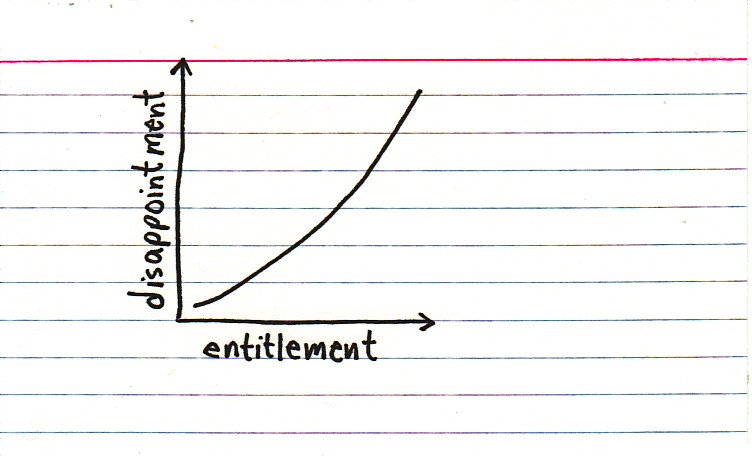
(c) Jessica Hagy
Subscribe to:
Posts (Atom)


